
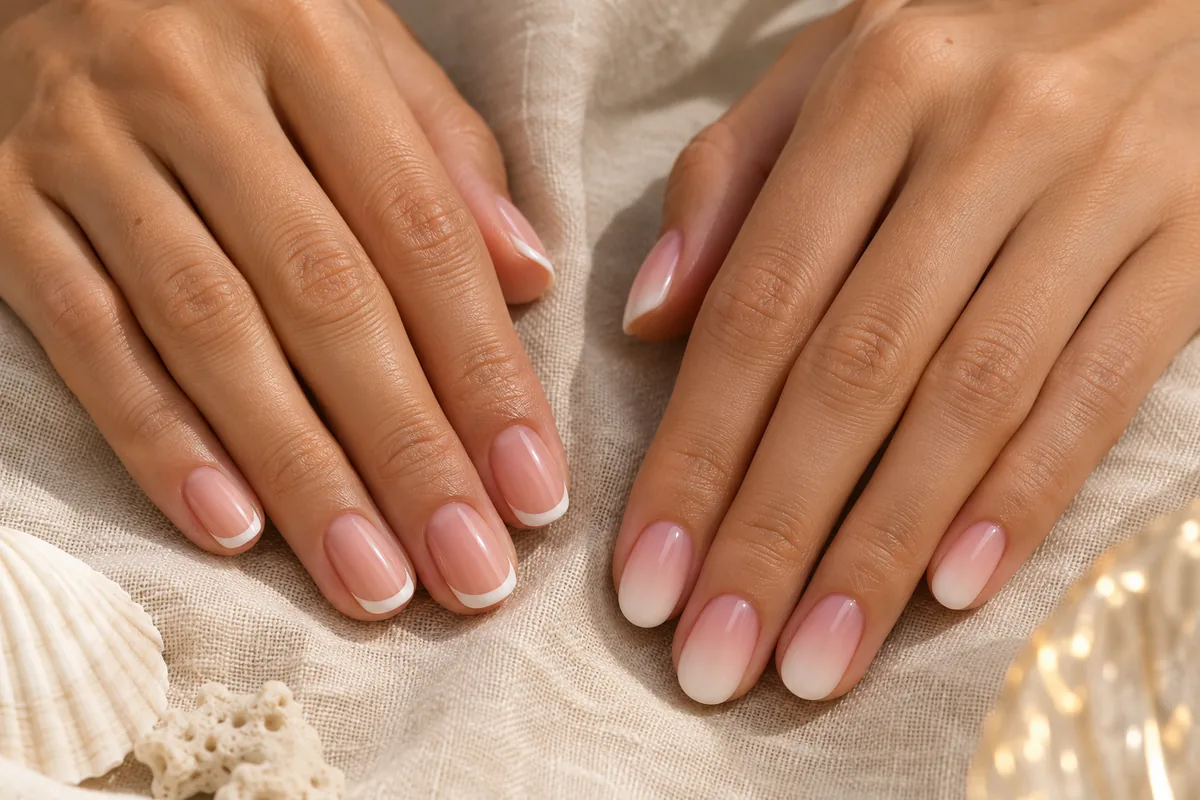
French and ombré nails organize color differently. A French design uses a more defined tip; ombré blends colors across the nail. Neither requires one fixed color palette, so deciding between them is really a choice about the transition you want to see.
Decide on a defined or blended edge
| Feature | French direction | Ombré direction |
|---|---|---|
| Color transition | A visible tip boundary | A softer blended transition |
| Main proportion | Tip width against the base | Where the blend begins and ends |
| A softer look | A narrow tip with low contrast | Related shades blended gradually |
| A stronger look | A contrasting tip | A more noticeable color change |
Consider the nail length
A wide French tip can dominate a short nail, while a narrow line leaves more of the base visible. An ombré blend also needs to be planned around the available surface. Explain the length you want before deciding how closely to follow a reference photographed on a longer set.
Choose the system separately
The SNS menu lists SNS French from $55+ and several ombré options from $60+. The acrylic menu includes pink-and-white and ombré choices as well. These entries belong to different services; the design name alone does not identify the product system or every included step.
Ask which approach fits your current nails and whether added length is part of the request. Confirm removal, shape, length and any extra artwork before comparing totals.
Make the reference precise
For French, point out the tip color, width and curve. For ombré, identify the two colors and how subtle or pronounced the transition should be. A phrase like “soft pink nails” may describe either style and leave the most important detail unclear.
Read micro French ideas for a narrower-tip approach or SNS ombré choices for different blended finishes. Browse the gallery for visual inspiration, then discuss what can be adapted to the actual length and service you select.
Menu references checked November 4, 2026. Confirm current prices, included steps and appointment availability with the salon.
Three ways to use the same pink-and-white palette
Changing the edge between two colors can change the whole set, even when the shades stay similar. These three briefs make that difference easier to explain:
- A crisp classic French: a pink base with a clear white tip and a visible curve between them. The outline of the tip is the main detail.
- A softer micro French: a sheer pink base with a very narrow, warmer white edge. More of the base remains visible, and the contrast is less pronounced.
- A gradual pink-to-white ombre: pink near the base blending toward white at the tip. The transition itself becomes the feature, so its starting point matters as much as the final white color.
When adapting a long reference to shorter nails, identify what you want to preserve. For French, that might be the fine edge rather than the original tip depth. For ombre, it might be a small pale area at the end rather than a long band of white. Simply shrinking every detail can give a different visual balance.
Also compare the base coverage. A translucent base shows more of the natural nail beneath it; a more covering base creates a different background for the tip or blend. This is a separate choice from the nail shape and product system. If a narrow edge is your priority, the short-nail micro French guide develops that direction further.
Published by Luxury Nail & Spa. Updated .